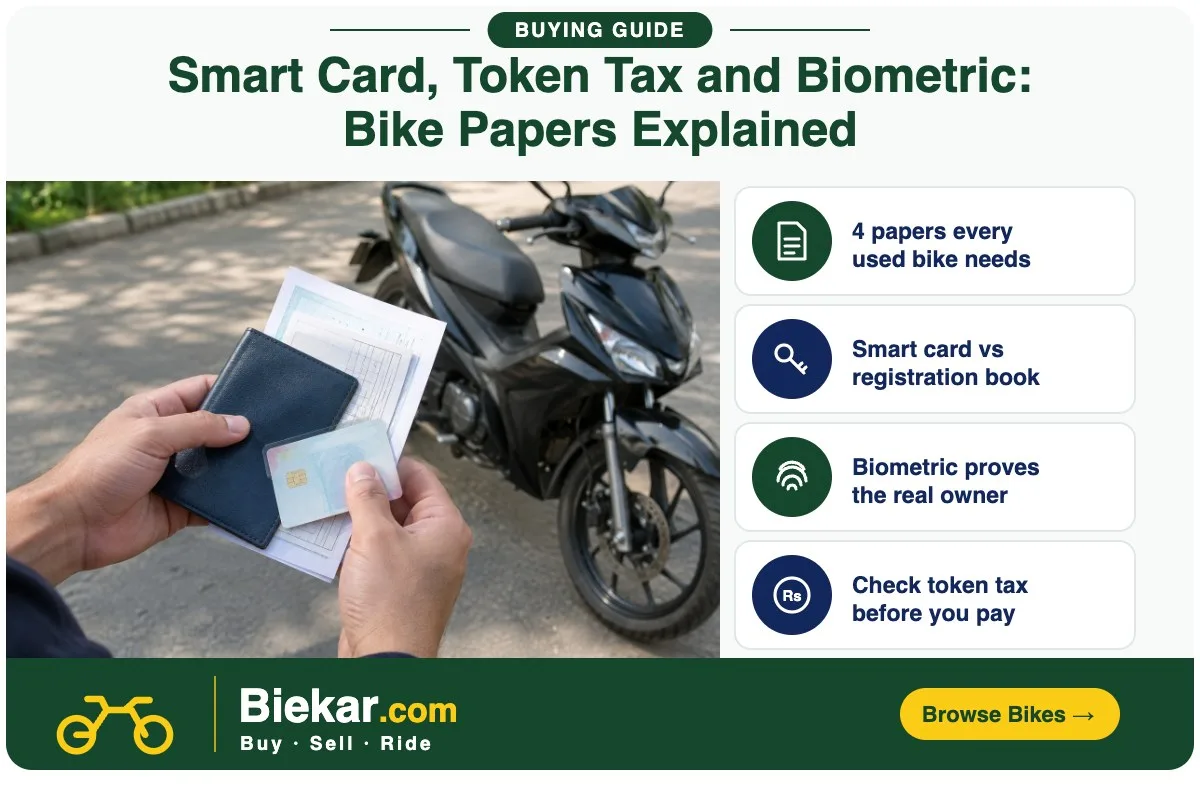
If you are buying or selling a used motorcycle in Pakistan, the paperwork matters as much as the engine. A bike with unclear papers can be hard to resell, can bring fines, and in the worst case can be linked to a crime you had nothing to do with. This guide explains in plain words what the registration book, smart card, token tax and biometric verification are, why each one matters, and how to check them before you hand over any money. Rules and fees differ by province and change from time to time, so always confirm the current process with your local excise and taxation office.
The four papers every used bike should have
Whatever the model, ask the seller for these items before you talk about price. If any of them is missing, treat it as a warning sign and slow down.
- Registration book or smart card: the main proof that the bike is registered and in whose name.
- Token tax receipts: proof that the yearly motorcycle tax has been paid.
- CNIC of the registered owner: the seller should match the name on the papers.
- Transfer or sale letter, where needed: written proof that ownership is changing hands.
Registration book and smart card explained
Every registered motorcycle is recorded with the excise department of its province. The registration book was the traditional proof of ownership. In many areas it has been replaced or supported by a registration smart card that carries the owner and vehicle details. Both show the registration number, make, engine number, chassis number and owner name. When you look at either one, read every line slowly and compare it with the bike in front of you.
What to compare on the bike
Find the engine number and chassis number stamped on the bike and match them letter by letter with the papers. Look for signs of scratching, grinding or re-stamping around the numbers. If anything looks changed, walk away. Our used motorcycle checklist shows where to find these numbers and what else to inspect.
Token tax: what it is and why it matters
Token tax is the annual tax that owners pay to keep a motorcycle legally on the road. When you buy a used bike, ask to see the receipts, not just a promise. Unpaid tax usually stays attached to the bike, which means the new owner can be asked to clear it. Ask the seller to pay any pending amount before the sale, or agree clearly in writing who will pay it. Check the current amount and the payment method with the excise office or its official website instead of trusting a figure from a friend or an old post.
Biometric verification: proving the real owner
In some provinces, including Punjab, ownership transfer and registration steps may require biometric verification. In simple terms, the seller and the buyer visit the designated office or centre so that their identity is confirmed by fingerprint against their CNIC. The idea is to stop fake sellers and stolen vehicles from being sold. Because the exact procedure, the offices involved and the documents you must carry can change, check with the excise office before you go, and take both original CNICs.
Why you should not skip it
- It confirms that the person selling is the person on the papers.
- It protects you if the bike is later questioned by the police or excise staff.
- It leaves an official record that you are the new owner.
Step-by-step: from agreement to transfer
- Check the papers first. Inspect the registration book or smart card, token receipts and the owner's CNIC. Match the engine and chassis numbers.
- Verify the bike and the seller. Meet in a public place during daytime. Ask why the seller is selling and note whether the story stays consistent.
- Agree the terms in writing. Write the price, the date, both names, CNIC numbers and the bike details on a stamp paper or sale letter as advised by your local office.
- Complete the transfer at the excise office. Both parties attend with originals and copies. Follow the officer's instructions on forms, fees and verification.
- Collect the new papers. Do not consider the sale finished until the registration is updated in your name. Keep copies of everything.
For a more detailed walk-through of the full process, read our guide to transferring motorcycle ownership in Pakistan.
Common paperwork mistakes
- Paying in full before the transfer. Pay the balance only when the transfer is done or at the office, never before you have seen the papers.
- Accepting a photocopy. Always see the originals.
- Skipping the written agreement. A verbal deal is hard to prove later.
- Leaving the bike in the old owner's name. Any fine, tax or legal problem can then fall on the wrong person.
- Ignoring outstanding challans or tax. Ask for proof that nothing is pending.
Tips for sellers
If you are selling, gather your papers before you post the ad. A bike with a clean registration book or smart card, paid token tax and a ready seller sells with less haggling. Mention in your ad that papers are complete, add clear photos, and describe the condition honestly. You can post your bike free on Biekar, and buyers can browse used bikes in your city, for example bikes for sale in Lahore, Karachi or Islamabad. Popular brands such as Honda, Suzuki and Yamaha each have their own page.
Tips for buyers
Do not let a good price or a pushy seller hurry you. A fair deal survives a day of checking. Take a friend or a trusted mechanic, photograph the papers and the engine and chassis numbers, and decide only after everything matches. If the seller refuses biometric verification or the office visit, that is reason enough to say no. When you start your search, browse all bikes for sale in Pakistan and shortlist only those whose ads mention complete papers.
Frequently asked questions
Can I buy a bike without a smart card?
It is risky. Without proper registration proof you cannot be sure who owns the bike. Ask the seller to show the registration book or other official proof and confirm with the excise office what is acceptable in your area.
Who pays the pending token tax?
This is something you agree before the sale. The safest approach is for the seller to clear it first and show you the receipt.
Is biometric verification always required?
Requirements depend on the province and can change. Check with the local excise office before you plan the transfer.
Purani bike khareedne se pehle kya dekhna chahiye?
Sab se pehle registration book ya smart card, token tax ki raseed aur seller ka CNIC dekhein, phir engine aur chassis number bike se match karein. Bike transfer karwaye baghair raqam poori ada na karein.
Final thoughts
Good paperwork does not guarantee a good bike, but missing or doubtful paperwork almost always signals trouble. Take the time to check the registration, tax receipts and identity, complete the transfer properly, and keep your own copies. A few hours at the excise office can save you months of trouble. Once everything is in order, you can enjoy the ride, and when it is time to sell, you will have clean papers that buyers trust.
Bikes in this article
Looking for your next bike?
Browse thousands of new and used motorcycles from sellers across Pakistan.
Browse BikesMore articles
 Buying Guide
Suzuki GS 150 vs Honda CB 150F: Which Should You Buy?
A practical way to compare the Suzuki GS 150 and Honda CB 150F: riding feel, running costs, parts and what to check on a used bike.
 Buying Guide
Used Bike Prices in Lahore, Karachi and Islamabad: What Affects Them
Why the same used bike is listed at different prices in Lahore, Karachi and Islamabad, and a simple step-by-step way to find a fair price in your city.
 Buying Guide
Honda CD 70 Price in Pakistan: What You Will Actually Pay (New vs Used)
There is no single price for a Honda CD 70. Learn what moves new and used prices in Pakistan and how to find a fair figure yourself.